
Introduction
Welcome! We’ll get you started with building your first trading strategy, and don’t worry—it’s easier than it sounds!
What is a Trading Strategy?
At its core, creating a trading strategy means deciding when to buy stock, sell stock, or do nothing. We do this by assigning trading signals to a table of stock data.
Trading Signal Basics:
- 1 → Buy
- -1 → Short
- 0 → No Investment
These signals will guide the backtesting engine to simulate what would’ve happened if you’d followed those decisions with historical stock data.
Here’s What It Looks Like:
Your strategy will parse through historical stock data, (hopefully) uncover patterns, and generate a column of signals that dictate buy/sell actions—just as if you were making decisions in real-time with the data at hand. The end result of signals might look as simple as this:
signal01111...Don’t worry, we will show you how to do this.
What Happens Next?
The backtesting engine will take these signals and simulate trades, showing you how a strategy would have performed in the past, without introducing the bias of the future. This gives you the chance to evaluate your approach and refine it to improve your results.
Does It Sound Hard?
Don’t fear! We’re here to make it easy for you. The following is all that is required for a simple buy-and-hold strategy:
def strategy(data): data['signal'] = 1 # Always buy return dataWhat does this look like in the Strategy Editor?
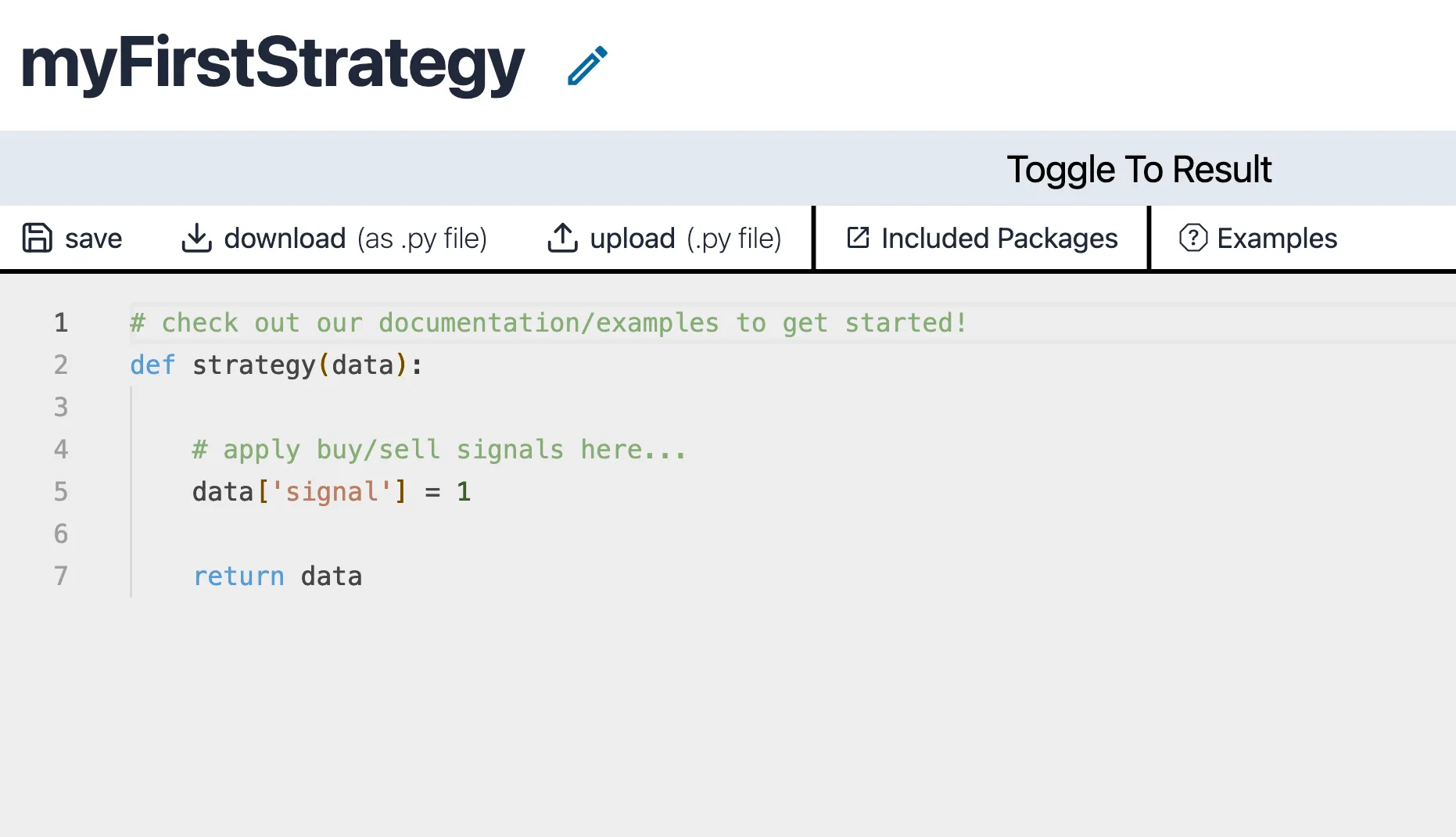 beautiful.
That’s it! You can tweak it further as you learn and grow in building more complex strategies.
Ready to dive in? Let’s get started!